
Authorized Trading Partners (ATP)
Authorized Trading Partner


.webp)


%201.webp)



%201.webp)




Serialization is not one-size-fits-all. With varying mandates across the U.S., EU, Asia, and the Middle East, companies must navigate a complex web of requirements. Are you prepared for global compliance?
.avif)
If you're passionate about making a difference and thrive in a collaborative environment, LSPedia is the place for you.

Answer four questions to see what applies to you — then see how independent pharmacies run the rest of it with Pharmacy Pro.
Answer these four questions.
DSCSA applies to you — and most of what it asks is already enforceable. See what's required now →
Not every dispenser looks the same on paper. Talk to our team to confirm exactly what applies to you.
DSCSA compliance for pharmacies means four things today: buying only from authorized trading partners, checking product identifiers, investigating and reporting suspect product, and keeping six years of records. If you have 25 or fewer full-time pharmacists and technicians, only the enhanced electronic tracing requirements are deferred until November 27, 2027.
Deferred*
Enhanced electronic tracing requirements.
*Only if you have 25 or fewer full-time pharmacists and technicians.
No exemption
These apply to every dispenser now.
Authorized trading partner checks
Product identifiers
Suspect-product investigation and reporting
Six years of records
You don't have a year to get ready. You need to be ready now.
Six of these seven steps are procedure — you do the same thing whatever's in the tote. Step five is a decision, and nothing moves until whoever's on shift makes it.
This is where Pharmacy Pro standardizes your procedure, walking whoever is on shift through the same four steps to resolve exceptions.
The product is held before it reaches a shelf or a patient, so nothing moves on an assumption.
Against the supplier record and the data you were sent, in one place — not a phone call and a portal.
Accept it, return it, or report it. The decision is guided by your SOP, not by what somebody remembers.
The product, the check, the decision and who made it are captured as you go — the record exists without anyone keeping a separate log.
The power is that months later you can show what you did and why — not in general, but on that specific product.
Your suppliers' shipment data arrives in one place and matches itself to what you scanned. When something doesn't match, you see it at the bench — not in a month-end report.
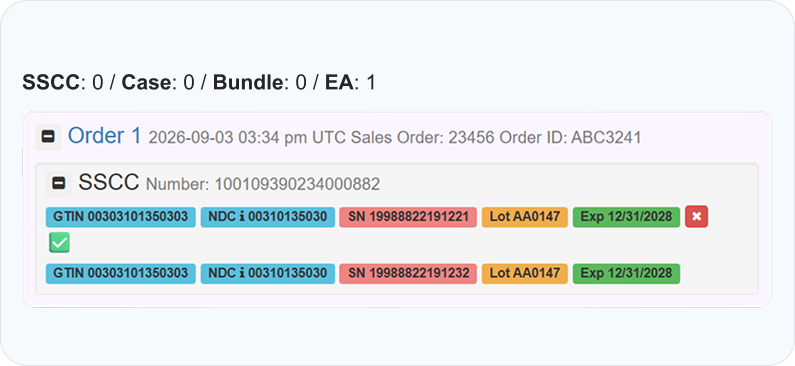
When something arrives wrong, Investigator walks whoever's on shift through the same steps: hold it, check it, decide it, and record it.
Lot #C7745 — awaiting decision against SOP §4.2
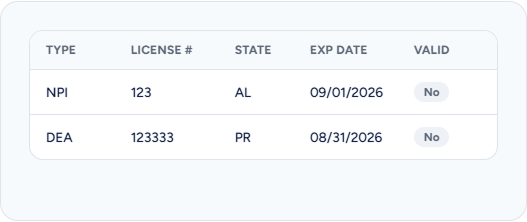
Authorized trading partner records, current and in one place. “Are they licensed?” becomes a lookup, not a project.
Every tote adds to a trail you can pull in seconds: when it arrived, what the data said, who decided what. That lookup is what “show me” looks like in an inspection.
9:14 AM
Lot #A2291 received & matched — J. Alvarez
9:16 AM
Lot #C7745 held for review — J. Alvarez
9:41 AM
Lot #C7745 decision: returned — M. Ortiz
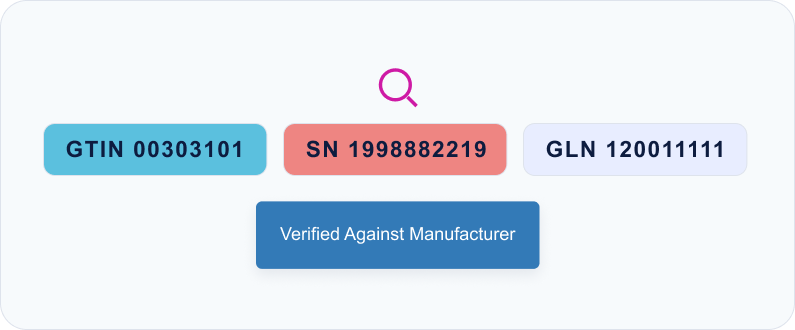
When something looks wrong, you need to know whether that specific package is what it claims to be. Product verification puts the question to the manufacturer against that serial number.
Four questions an inspector asks first. Tap each one to see what a good answer sounds like.
01 What is DSCSA?
A good answer to this is short, and it's about patients rather than statute: DSCSA is the federal law that tracks prescription drugs by serial number, so a counterfeit drug can't reach a patient.
If the only answer anyone in the building can give is “it's a federal law,” that's the gap the inspector is testing for — and it's the answer they hear most often.
02 What is your process?
A good answer is one single process, described exactly the same way by whomever an inspector or auditor asks — what happens when a delivery arrives, who scans, what gets checked against what, and what happens when something doesn't match.
The answer lives in an SOP someone can produce, not in a binder in an office nobody on the floor has opened.
03 What do you do if you doubt a drug?
A good answer describes a sequence: hold the product, investigate it against the supplier record and the data you were sent, decide what to do against what your SOP says, and record the reasoning against that specific product. If it turns out to be illegitimate, you notify FDA and your trading partners within 24 hours.
Quarantining everything by default is also a wrong answer — with shortages running daily, over-quarantining can be its own patient-safety problem.
04 Where is your quarantine area?
A good answer is a place you can walk to — not “we'd set it aside.” The quarantine area should be somewhere physically separate and identified, that staff can point at without hesitating, where suspect product sits so it can't be dispensed by accident while it's being investigated.
When you become a Pharmacy Pro customer, we don't leave you alone with a manual. We've put a variety of resources at your disposal.
Real answers to real questions that real pharmacies and dispensers have asked.
Live sessions where customers bring questions and issues to our DSCSA experts.
From a team that works DSCSA regulations every day.
Monthly webinars on what's changing and what it means for dispensers.
Accredited DSCSA CE bootcamps for Dispenser Operations and Dispenser SOPs.
Hussein Salman, Lead Pharmacist, Pioneer Pharmacy Services
“Thanks to their expert team, our audit was smooth and successful.”
- Hussein Salmann, Lead Pharmacist
Choose from plans built around core DSCSA compliance, product verification, PMS connectivity, training, configured SOP support, and outbound workflow needs.


Almost certainly. If you buy prescription drugs from a wholesaler or manufacturer, take ownership of them on delivery, and store them before dispensing, the law treats you as a dispenser. That covers independent pharmacies, chains and health-system outpatient pharmacies alike. Size doesn't exempt you from the law — it only affects which parts apply, and when.
Yes, if they buy and administer prescription drugs. The law names retail, hospital and chain pharmacies, then adds anyone else authorized to dispense or administer — the clause that brings in clinics, physician practices and med spas. In April 2026, FDA's first warning letter to a dispenser went to a medical spa, over purchasing outside authorized trading partners.
It moved one thing. Dispensers with 25 or fewer full-time pharmacists and technicians are exempt from the enhanced electronic tracing requirements until November 27, 2027. Nothing else moved — trading partner checks, product identifiers, suspect-product investigation and reporting, and six years of records are enforceable today.
No. It's automatic if you meet the threshold — 25 or fewer full-time pharmacists and technicians. There's nothing to file and no form to submit.
Six years. That applies now, not from 2027 — it's one of the four things enforceable today, and it's what an inspector means when they ask you to show a specific product's history rather than describe your process.
An inspector asks basic questions early: what DSCSA is, what your process is, what you do when you doubt a product, and where your quarantine area is. Then they ask you to show it — the records for a specific product, not a general description. Most findings come from not being able to answer, rather than from having done something wrong.